
Gilliam County Projected Versus Actual Release
A projected or scheduled date is an administrative forecast. The actual release date is a completed custody event. For a local case, NORCOR may display Scheduled Release while the adult is still on its live list. For a state prison term, Oregon Offender Search may display a projected release date. Neither field proves that the person later passed out of custody.
A pretrial detainee often has no fixed sentence-based date. Release can depend on security, recognizance conditions, a new court order, and the absence of another hold. A sentenced adult has a legal term, but a public forecast still reflects information known at the time. Always preserve the source's exact field label and the date it was checked.
- Court sentence
- The legal term imposed in the signed judgment.
- Scheduled release
- NORCOR's prospective field for a person still listed in local custody.
- Projected release date
- ODOC's current estimate for a covered state prisoner.
- Actual release
- The completed exit or transfer event recorded by the custodian.
Find Gilliam County Projected Release Dates
The correct route depends on the custodian. NORCOR holds many adults on Gilliam matters but is a regional jail in The Dalles. ODOC manages state prison sentences at institutions elsewhere in Oregon. The court supplies the judgment; it does not maintain a live jail door log.
- Check the NORCOR Adults in Custody list for a local adult. Record the timestamp and Scheduled Release label exactly.
- Open the Gilliam court register and obtain the signed judgment or release order. Determine whether the case is pretrial, a local sentence, or a state prison sentence.
- For a state prisoner, search the Oregon Offender Search by name and confirm the match with the SID.
- Ask NORCOR whether a local scheduled date includes jail credit and any authorized local reduction. The public table does not show its arithmetic.
- For an unclear ODOC computation, request the sentence-computation record and identify the judgment, SID, and date field at issue.
- After the expected date, obtain the actual release or movement event and check whether supervision or another custodian followed.
The Gilliam County released inmate search provides the full cross-system sequence when the person vanishes from one source. A no-result should never be converted into an exact release date.
Gilliam County NORCOR Scheduled Release
NORCOR's live table shows a generated timestamp, current count, name, booking date, lead charge, bail, and Scheduled Release. The row belongs to a person still shown as an adult in custody. The page does not display actual release time, receiving agency, release reason, or a past-release archive.
A local sentence date may depend on jail credit, the court judgment, and an authorized reduction. The public table does not disclose that calculation. Weekends, new holds, sanctions, court changes, and checkout processing may cause the observed exit to differ from a hand estimate.
The official screenshot below shows the NORCOR current list and its prospective date field.
Review NORCOR's current Scheduled Release entries.
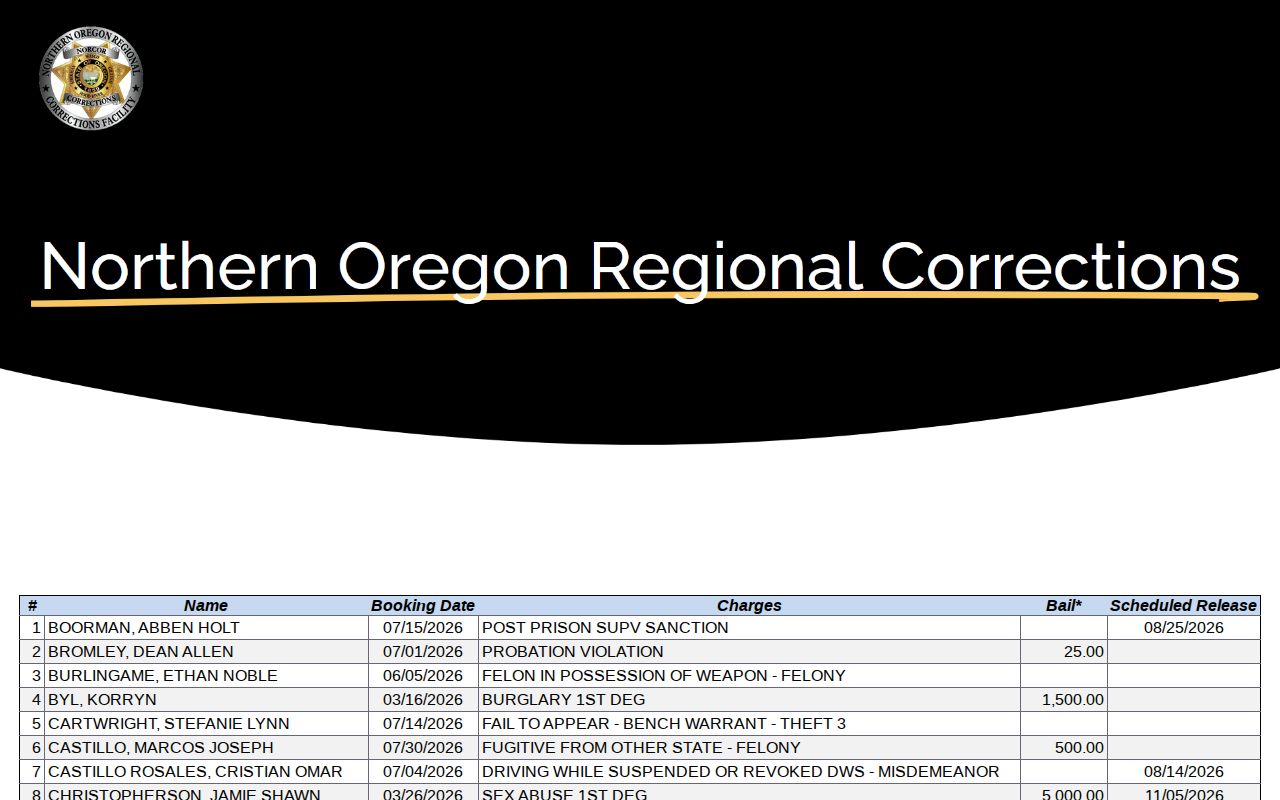
The timestamp and current-custody context should be saved with the date rather than treating the screen as later proof of release.
Note: A bail release follows court and checkout steps, not sentence-credit math, even when the roster displays a scheduled field.
Gilliam County ODOC Projected Release
Oregon Offender Search is the state-prison route. Search by surname and first name, then verify the SID and institution before recording any date. OOS can include the projected field for a person currently imprisoned. It can also show parole, post-prison supervision, or a community corrections location after physical release.
The public result is not a permanent discharge archive. OOS Help limits coverage to people currently in DOC custody or a local Community Corrections office. Someone fully discharged may disappear, while a person outside prison can remain listed under supervision. An ODOC no-result therefore does not supply an actual date or prove the person was never in NORCOR.
For a historic or disputed computation, request the ODOC time-computation or discharge record. Give the SID and identify the exact field and judgment. ODOC may redact protected medical, victim, security, or other exempt information and may estimate lawful retrieval costs.
Capture every nearby label rather than copying the date alone. Institution, custody or supervision status, SID, and the access date help explain which phase the record describes. If OOS later drops the person after full discharge, the saved public result remains only a dated snapshot. An ODOC public record is the stronger archival source.
Gilliam County Earned-Time Release Rules
Oregon does not have one blanket rule requiring every person to serve the same percentage. ORS 421.121 permits eligible adults serving qualifying post-1989 felony terms to earn a reduction for proper institutional conduct and participation in basic-skills programs. The maximum reduction is 20 percent of the total DOC institutional term, and actual confinement cannot be reduced below six months under that provision.
That is a cap and eligibility framework, not a promised award. ORS 421.121 excludes sentences governed by several listed provisions, including Measure 11 and specified murder or mandatory-sentence statutes. The judgment, offense, crime date, sentence structure, conduct, and current ODOC calculation all matter.
Do not calculate a Gilliam County projected release date by subtracting a fixed percentage. Ask for the judgment and the ODOC computation when a precise explanation is needed.
Eligibility can also depend on the sentence date and the exact statute cited in the judgment. Appropriate behavior and program participation support earned time only within the governing provision. A maximum possible reduction is not the same as credit already earned, and a disciplinary change can alter the later forecast.
Note: The statutory maximum reduction is not an individual award and cannot replace ODOC's current sentence computation.
Gilliam County Measure 11 Release Dates
ORS 137.700 generally requires the full mandatory minimum for listed Measure 11 offenses and dates. Ordinary earned time under ORS 421.121 does not reduce that covered minimum. ORS 137.712 contains limited exception mechanics for certain listed crimes when the court makes the required findings.
Sentence-specific authority controls. A court may also address eligibility for authorized leave, reduction, work release, conditional release, or supervised release under ORS 137.750. Concurrent or consecutive terms and qualifying presentence credit under ORS 137.370 form part of the computation. A short online result cannot replace the signed judgment.
Concurrent terms run together to the extent ordered, while consecutive terms run one after another. Presentence credit depends on qualifying custody and the judgment or computation. These details make informal calendar math unsafe. The current signed orders and ODOC calculation should resolve the structure.
Gilliam County Transitional Leave Dates
Short-Term Transitional Leave, or STTL, explains why physical placement and final discharge can diverge. ODOC says an eligible person with an approved county plan may move to community placement up to 120 days early, depending on sentence date and the department's discretion.
STTL does not create final discharge. The person remains under legal custody and may be returned for a violation. When an ODOC result or release plan mentions transitional leave, describe the community placement and the continuing legal control rather than calling the sentence complete.
A county-approved release plan and ODOC discretion are separate from the sentence expiration date. The community placement may start before final discharge, yet supervision duties remain. The actual movement and the later discharge should be recorded as two events.
Gilliam County Release Date Changes
A projected date is a snapshot of an active computation. The table below identifies common record-supported reasons it may move. The exact cause must be confirmed through the agency or court record.
| Factor | Possible effect | Record to check |
|---|---|---|
| Presentence jail credit | Changes credited time applied to the sentence | Judgment and ODOC computation |
| Earned-time award or loss | Moves an eligible prison forecast | ODOC computation and conduct record |
| New or corrected court order | Changes counts, terms, or concurrent structure | Signed court order |
| Detainer or other hold | Prevents community release or causes transfer | Custody movement and receiving-agency record |
| Board decision | Sets, affirms, defers, or postpones a parole date when applicable | Board final order |
| STTL approval or revocation | Changes physical placement without final discharge | ODOC leave and supervision record |
| NORCOR processing | Changes door time after a court or payment event | Actual NORCOR release event |
A change is not proof of error. Administrative recalculation can follow new jail credit, overturned counts, later orders, discipline, credit adjustments, or a new detainer. Request the source records before drawing a conclusion.
Note: Compare the new forecast with the judgment and computation record before treating a moved date as an agency mistake.
Gilliam County Release and Discharge Dates
The Oregon Board's sample Order of Supervision uses separate labels for Physical Release Date, Parole Release Date, Sentence Expiration Date, Post-Prison Supervision Expiration, and assigned office or caseload. Those dates may differ. One unlabeled “release date” cannot show when all legal control ended.
A state prisoner may leave the institution and report to Gilliam-Wheeler Community Corrections. That is physical prison release with continuing supervision. A NORCOR adult may finish a local stay and begin probation under the Gilliam judgment. In both cases, discharge requires its own final record.
Confirm Gilliam County Actual Release
After a projected date arrives, check the actual custodian. NORCOR can provide its release or custody-movement event for a local adult. ODOC maintains the prison release and sentence-computation record. A court document explains the authority, while the assigned community corrections office can confirm public supervision routing.
Oregon VISOR can provide custody or supervision notifications when the responsible agency participates. It is the current Oregon system, not the former VINE/VINELink process. Its information is periodically updated and is not the official record. The Gilliam County VISOR search instructions explain the current account and guest paths.
Save the source name, exact field label, date, and check time. If NORCOR, VISOR, the court, and OOS conflict, ask for the underlying record rather than choosing the most convenient date.