
Where BOP Releases Go
A federal prison release can place a person in the community, a residential reentry setting, another authority's custody, or immigration detention. Federal supervised release may also follow imprisonment. That court-ordered oversight is separate from Oregon parole, post-prison supervision, and Gilliam County probation. The BOP record establishes only the federal prison custody event it reports.
“Released” in a locator row means the person is no longer in BOP custody according to that record. “Not in BOP custody” is broader and can cover a person held elsewhere, one never committed to BOP, or a former prisoner. Neither phrase proves that all legal control ended. Check the federal court docket, supervising authority, ICE, and state systems when the known facts support those paths.
Confirm a BOP Release
Open the official BOP Inmate Locator. A register number is the strongest search key. The name search permits age, race, and sex filters, which help separate common names but should not replace a known identifier.
- Search by BOP register number when it is available.
- Otherwise search the full name and use only accurate filters.
- Compare the name, register number, age, race, and sex before selecting a row.
- Record the release date, location, and status exactly as shown.
- Review the federal docket or other custodian when BOP has no result or the status is unclear.
The official BOP locator interface is captured below.
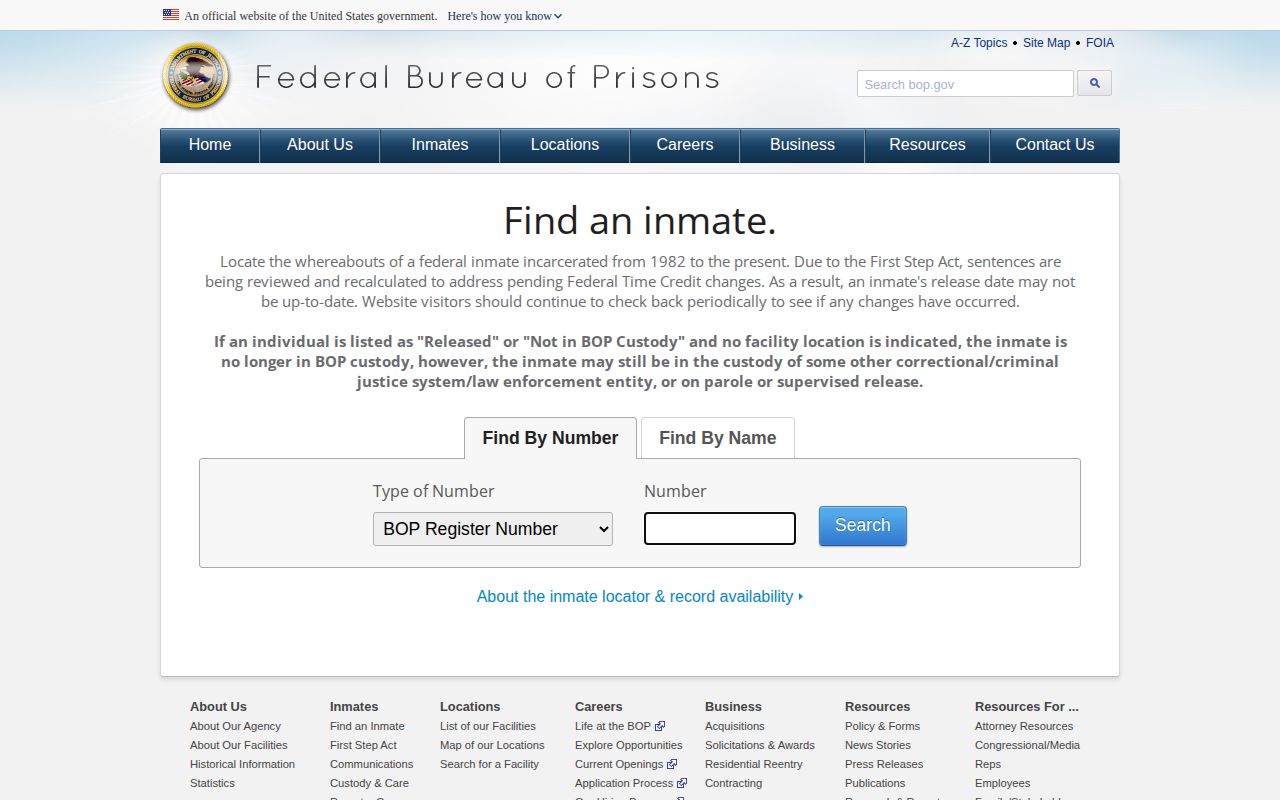
Its federal identifiers and filters are distinct from NORCOR booking numbers and Oregon SID records.
BOP Release Records
The public locator is the first record-access route for a sentenced federal prisoner. Capture the whole row and the date checked. For a record beyond the locator, use the appropriate BOP records or federal Freedom of Information Act process and identify the prisoner by register number. A broad request can be slow and may draw lawful redactions.
Institutions nationwide
Public route: BOP Inmate Locator
No BOP institution is located in Gilliam County.
Ask for a defined record, such as the public release data connected with a specific register number. Do not send Gilliam jail questions to BOP. NORCOR keeps its own booking and exit event. The federal court keeps its orders and docket. USMS controls many pretrial custody records, subject to federal disclosure limits.
Gilliam Has No BOP Prison
The BOP entry represents a nationwide system, not a local Gilliam facility. A federal defendant can be arrested in Oregon, held by USMS in a contract jail, sentenced in federal court, and assigned to an institution in another state. The federal locator follows BOP records rather than county geography.
That distinction prevents a common misread. Leaving NORCOR under a federal hold may be a transfer to USMS, not a BOP release or community return. Likewise, a BOP former-prisoner row does not establish the result of an open Gilliam case. Each authority must confirm its own custody event.
USMS Pretrial Custody
The U.S. Marshals Service holds many federal defendants from a detention order through acquittal, court release, or delivery to BOP after conviction. Those people may be housed in state, local, or private facilities. USMS does not provide a public person-by-person prisoner locator.
A BOP no-result therefore has limited meaning for a pretrial defendant. Use the federal court order and docket, counsel, and USMS prisoner information. Public disclosure of movement details, histories, photos, arrival times, and departure times is restricted. A narrow FOIA request may still face exemptions.
Note: Federal pretrial custody can exist without any matching sentenced-prisoner row in the BOP locator.
Gilliam Federal Release Systems
Use the authority named in the case or transfer record. One person can move through more than one system, and the dates can describe different stages.
| System | What it covers | Best public path |
|---|---|---|
| BOP | Sentenced federal prison custody and released rows. | BOP Inmate Locator. |
| USMS | Many federal pretrial detainees and transport to BOP. | Federal court record and limited USMS inquiry. |
| ICE | Civil immigration detention. | ICE Online Detainee Locator. |
| NORCOR | Regional adult jail custody serving Gilliam. | NORCOR current list and custody-event request. |
| ODOC | Oregon state prison custody and covered supervision. | Oregon Offender Search. |
The Gilliam released-inmate search connects the local and state routes. A transfer record should be followed to its named receiving authority instead of being reported as community release.
Four-County NORCOR Federal Transfers
Gilliam is one of four counties that developed NORCOR, the regional jail in The Dalles. A federal custody path can therefore begin at a facility outside Gilliam County even when the local arrest or case has a Gilliam connection. The NORCOR booking and movement record identifies its custody episode. The federal court and receiving federal agency control what follows.
A NORCOR handoff to USMS is a transfer, not community release and not proof that BOP has accepted the person. USMS manages many federal defendants before trial and through delivery after conviction. Only a later BOP record establishes the Bureau's custody status. This four-county structure explains why searching only Gilliam government pages or only the national BOP locator can miss an important stage.
Read BOP Release Results
BOP results can show name, register number, age, race, sex, release date, and location or status. These fields identify a federal record and report the Bureau's custody status. They do not show every court condition, state warrant, immigration action, or period of supervised release.
- Register number
- The federal prisoner identifier used to distinguish records.
- Released
- No longer in BOP custody according to the displayed federal row.
- Supervised release
- Federal court-ordered oversight that can continue after imprisonment.
- Pretrial detention
- Custody before the federal case is resolved, often managed by USMS.
Report the row with its source and check date. If another authority appears in the federal docket or transfer record, check that authority separately. Avoid the unsupported statement that the person is wholly free from custody or supervision.
A federal sentence can also include more than prison. The judgment may order supervised release after confinement, and a violation can lead to later court action. The locator's prison release date does not describe the end date, conditions, or current standing of that separate term. Use the sentencing docket and the responsible federal supervision office for the public facts they can provide.
When a location field names a reentry center or another non-prison setting, transcribe the label without guessing the person's freedom of movement. BOP classifications and placements can change before the final release event. A dated screenshot or saved result helps show what the locator said at the time, but later confirmation is still needed for a current claim.
Federal and Oregon identifiers should never be swapped. A BOP register number belongs to the federal record. An Oregon SID belongs to state corrections. A NORCOR booking number belongs to the regional jail event. Using the right number with the right custodian sharply reduces false matches and speeds a focused records request.
When the search concerns a Gilliam arrest but no federal register number is known, begin with the court case and the NORCOR movement record. Those sources may show whether USMS received the person or whether the matter stayed within Oregon. Only then should a missing BOP row be weighed. This sequence avoids treating the national prison database as a universal federal custody list.
Reconcile Federal Release Records
A complete federal timeline may begin before BOP has a record. USMS takes custody of many defendants after a detention order and can place them in local, state, or private facilities. If the person is acquitted or released by the court before commitment, no sentenced-prisoner row may ever appear. After conviction, USMS generally delivers the person to BOP, which then records the institution and federal prison release data.
Use the federal court docket to identify the legal stage. A detention order supports pretrial custody. A release order, judgment, or later supervised-release filing answers a different question. Court action can authorize movement, but the docket may not report the precise time a holding facility completed it. BOP supplies its own custody status, while USMS limits public release of movement times, personal histories, and photos.
If NORCOR records a handoff to USMS, the regional jail event proves departure from NORCOR and names the next authority. It does not prove entry into a BOP institution. Search the locator after the federal commitment stage is known. If the person appears, preserve the register number, location, release date, and status. If no result appears, return to the federal docket and USMS framework instead of calling the movement a release.
An immigration transfer can occur before or after BOP custody. ICE uses a separate civil detention system and identifier. A BOP row marked Released does not rule out ICE detention. The ICE locator, receiving field office, and applicable federal record must be checked when the transfer facts support that path. Likewise, a pending Oregon warrant or Gilliam case is not resolved by the federal row.
Conflicts should be reported by source and time. Note when BOP was searched, the exact status, and which court or custody record points elsewhere. A location change may reflect designation, transfer, reentry placement, release, or a data update. Request the defined federal record when the public row is too short, and avoid asking an agency to certify events outside its control.
The safest conclusion remains narrow. BOP can show that a person is no longer in Bureau custody. The federal court can show its orders and supervised-release term. USMS can address its custody within disclosure limits. ICE can address immigration detention. NORCOR and ODOC control their own Oregon events. Only those linked records can describe the path from a Gilliam-related arrest through federal custody and later release.