
Where Oregon DOC Releases Go
An ODOC release can mean physical departure from a state institution while parole, post-prison supervision, or another community status continues. Parole is supervised release governed by the Board in cases within its authority. Post-prison supervision is a period of oversight after a prison term. Complete discharge occurs when the applicable correctional authority ends. Each label must remain distinct.
A Gilliam sentence may be served at any institution assigned by ODOC. No ODOC prison was identified in Gilliam County. If someone disappears from NORCOR and then appears at an ODOC institution, the movement is a transfer into state custody. It is not release to the community. If the ODOC record later shows a Community Corrections office, the person may be outside prison but still legally supervised.
Confirm an ODOC Release
Begin with the official Oregon Offender Search. Search by surname and first name, then confirm the State Identification number when available. Common names and aliases can cause false matches. The statewide system should never be substituted for NORCOR when the person served only a local jail term.
- Open the official search and acknowledge its terms or instructions.
- Enter the surname and first name. Use the SID to narrow a known record.
- Open the matching detail and copy the status exactly as displayed.
- Record the institution or supervision location and any projected or release-related date with the access date.
- Check the Gilliam judgment and request ODOC records if the public detail is absent or incomplete.
The official ODOC search form is shown in the capture below.
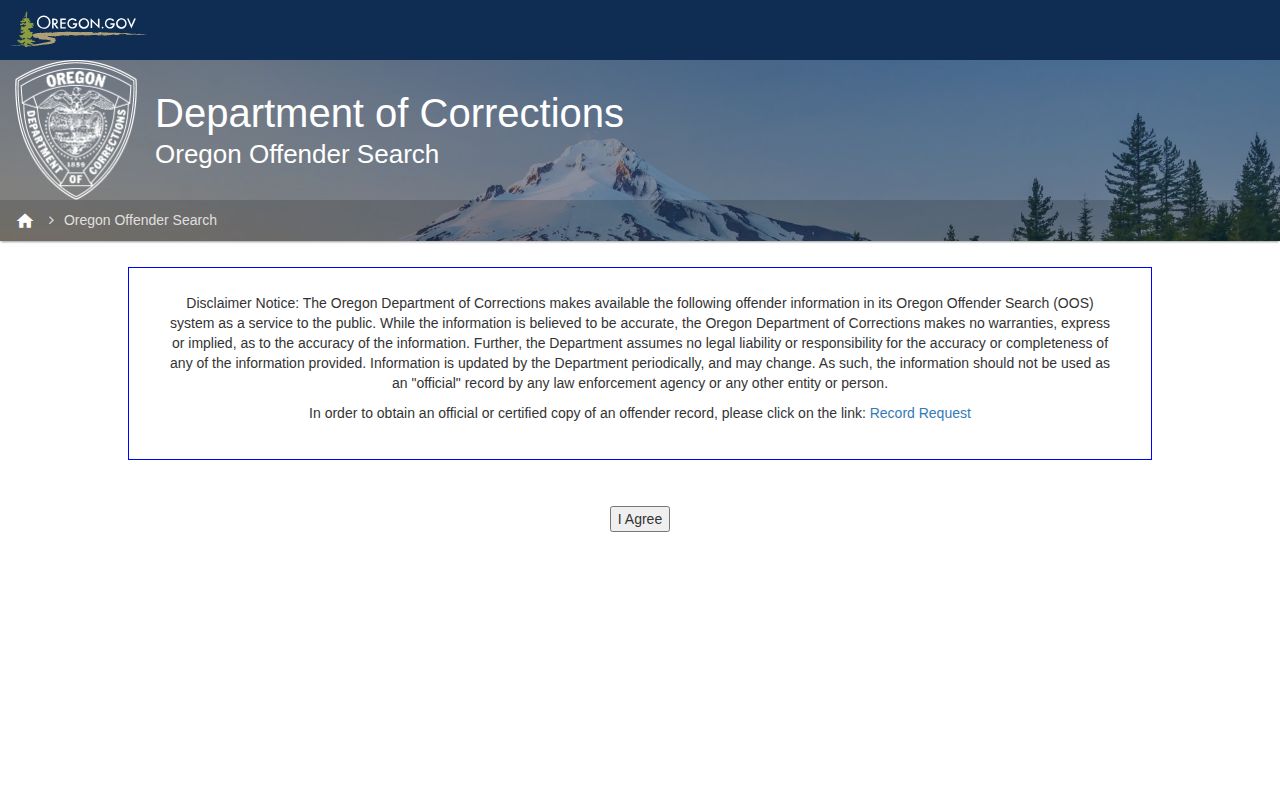
Its name and SID fields help separate people, while the detail page determines whether the record reflects prison, supervision, or another covered status.
ODOC Discharge Record Requests
OOS Help limits the public service to people currently in DOC custody or a local Community Corrections office. Fully discharged people may fall outside that coverage. A no-result cannot establish that the person was never imprisoned or that a sentence never existed. Historical discharge proof should come from ODOC public records.
Statewide institutions and Community Corrections coverage
Use the official Oregon Offender Search first.
Submit archival requests through the ODOC public-records page.
Identify the person by full name and SID. Ask for a release or discharge summary, time-computation record, or the specific public Pen Pack material needed. A Pen Pack may contain face sheets, a photograph, judgments and sentence orders, and public parole-discharge or revocation documents when present. ODOC may redact medical, victim, security, and other exempt information. It may also estimate staff or copying costs.
Gilliam Has No State Prison
ODOC is included as a receiving and releasing system, not as a Gilliam facility. NORCOR serves local adult jail custody. A Gilliam Circuit Court sentence can move a person from NORCOR into the state prison network, where ODOC chooses the institution. The county name in the case does not imply a prison location inside Gilliam.
This geography changes the record chain. NORCOR documents the handoff from regional jail custody. The Gilliam judgment supplies the sentence. ODOC holds the state admission, institution, computation, release, supervision, and discharge records. Gilliam-Wheeler Community Corrections may handle field supervision if Gilliam is the assigned county after prison.
Read ODOC Release Status
Preserve the source's exact terms. “Parole,” “post-prison supervision,” or a named community office usually means physical prison release with continuing oversight. An institution name points to confinement. A projected release date is an estimate for a person still imprisoned, not a completed release event. Full discharge requires a record that supports that conclusion.
| Displayed item | Careful reading |
|---|---|
| Institution | The person is associated with state prison custody at the check. |
| Community Corrections | The person may be outside prison but under local supervision. |
| Parole or post-prison status | Physical release does not equal discharge from authority. |
| Projected release date | An administrative forecast subject to later change. |
| No result | Could reflect no coverage, full discharge, identity mismatch, or another system. |
VISOR can provide custody or supervision notifications, but it is not the underlying sentence record. The Board record may explain a parole decision. A Gilliam court register explains case orders. Each source answers a narrower question.
Gilliam's Regional Transfer Path
Gilliam is one of four owner counties behind NORCOR, the regional adult jail in The Dalles. That local arrangement explains why a state-prison path can begin outside Gilliam even before ODOC assigns an institution. The NORCOR agency description documents the regional structure.
A sound timeline may contain several different events: Gilliam arrest, NORCOR booking, Gilliam judgment, NORCOR transfer, ODOC admission, institution changes, physical prison release, community supervision, and final discharge. Collapsing the timeline into one “release date” can create a major error. Use the identifier and authority attached to each event.
Note: A NORCOR-to-ODOC movement is a state transfer even though the person's name leaves the regional jail list.
ODOC Projected and Actual Release
The public application can show a projected release date. It depends on the judgment, sentence structure, presentence credit, statutory eligibility, earned-time awards, conduct, holds, and later orders. Oregon does not have one safe percentage that applies to every prisoner. Measure 11 minimums and earned-time rules vary by offense and statute.
Capture the displayed label and date as a dated snapshot. If the date moves, obtain the judgment and ODOC time-computation record. Administrative recalculation may follow corrected jail credit, a changed count, disciplinary action, awarded credit, or a detainer. A reader should not calculate or promise the actual door day from a public field.
- Projected date
- A forecast based on the sentence information then in the system.
- Physical release
- Departure from a prison setting, possibly into supervision.
- Discharge
- The end of the applicable correctional authority.
- Detainer
- A request or hold from another authority that can affect movement.
For a Gilliam local sentence, use NORCOR and the court instead. The statewide ODOC calculation applies only when the person entered its covered prison or supervision system.
When public status and a judgment seem inconsistent, note the access times and request the underlying computation. A court controls its sentence order, while ODOC administers the prison term under that order and current law. Neither a stale screen nor an unlabeled date should override a completed agency record.
ODOC Release and Supervision Proof
Physical prison release may start a supervised phase. Oregon distinguishes parole, post-prison supervision, and probation. Parole and post-prison supervision follow state prison cases under the authority shown in the judgment and correctional records. Probation is imposed by a court and may exist without a state prison term. Oregon Offender Search can name a Community Corrections office while the person remains within public coverage, but the label does not mean the person is still inside an institution.
For a Gilliam assignment, Gilliam-Wheeler Community Corrections is the local field office described in ODOC's biennial report. It operates from the Gilliam County Courthouse in Condon and covers both Gilliam and Wheeler Counties. The report describes a small frontier program working with both sheriffs and local providers. Staffing and contact details can change, so the judgment and OOS location should be checked before anyone travels or sends case details.
The Oregon Board of Parole and Post-Prison Supervision handles decisions within its statutory jurisdiction. Its public hearing calendar shows scheduled proceedings, not the result or actual prison exit. No public person-by-person decision search was found in the project sweep. When a Board decision matters, request the Board Action Form, final order, or other named public decision record using the person, SID, date of birth, and hearing detail.
A supervision order may separate several dates. Physical Release Date, Parole Release Date, Sentence Expiration Date, and Post-Prison Supervision Expiration can differ. One unlabeled date therefore cannot establish full discharge. The status should identify whether the person left a building, began parole, entered post-prison supervision, completed a sentence, or ended every covered correctional term.
VISOR adds notification, not archival proof. It searches people currently in custody or under supervision and can send a change alert. Someone out of prison may stay visible during community oversight. Someone fully discharged may disappear. Match the SID, agency, facility or office, event date, and displayed status, then confirm a disputed event with ODOC or the named county office.
When the public search no longer carries the person, request the historical state record. Name the release or discharge summary, time-computation record, or relevant Pen Pack parts. Include the SID and ask for electronic delivery and a fee estimate. A focused request gives ODOC a clearer search target and preserves the distinction between the sentence document, the calculated term, physical release, supervision, and final discharge.